What Happened to Ivar's Baby in History Vikings?
| | This article needs attention from an expert in history. The specific problem is: style; does non read like an encyclopedia article. (February 2018) |


"Hyngwar", Ivar'due south proper noun as information technology appears in Harley MS 2278, a fifteenth-century Middle English manuscript.[one]
Ivar the Boneless (Old Norse: Ívarr hinn Beinlausi [ˈiːˌwɑrː ˈhinː ˈbɛinˌlɔuse]; built-in in 800s–c. 873), likewise known as Ivar Ragnarsson, was a semi-legendary Viking leader who invaded England and Ireland. According to the Tale of Ragnar Lodbrok, he was the son of Ragnar Loðbrok and his married woman Aslaug. His brothers included Björn Ironside, Halfdan Ragnarsson, Hvitserk, Sigurd Snake-in-the-Eye and Ubba. Ivar is probably the same person equally Ímar.[2]
The origin of the nickname is non certain. "Ívarr beinlausi" could exist translated to "Ivar legless", but "beinlausi" could likewise exist translated equally "boneless", since "bone" and "leg" translates to the aforementioned give-and-take, "bein", in Old Norse.[3] Several of the sagas describe him equally defective legs/basic, while a passage in Ragnarssona þáttr (likewise known as the tale of Ragnar'due south sons) suggest it refers to male impotence.[4]
According to the Tale of Ragnar Lodbrok, Ivar'south bonelessness was the upshot of a expletive. His mother, Aslaug, was Ragnar'south third wife. She was described every bit a völva, a type of seer or clear-sighted. She said that she and her husband must wait three nights before consummating their marriage after his return following a long separation (while he was in England raiding). Even so, Ragnar was overcome with animalism after such a long separation and did not mind her words. Equally a consequence, Ivar was born with weak bones.[5]
Some other hypothesis is that he was actually known as "the Hated", which in Latin would be Exosus. A medieval scribe with simply a bones knowledge of Latin could easily accept interpreted it every bit ex (without) bone (bone), thus "the Boneless",[6] although it is difficult to align this theory with the direct translation of his name given in Norse sources.[5]
While the sagas describe Ivar's concrete disability, they also emphasise his wisdom, cunning, and mastery of strategy and tactics in battle.[vii]
He is often considered identical to Ímar, the founder of the Uí Ímair dynasty, which at various times, from the mid-ninth to the tenth century, ruled Northumbria from the city of York, and dominated the Irish Sea region as the Kingdom of Dublin.[8]
Chronology [edit]
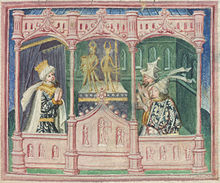
Lothbrocus and his sons Ivar and Ubba. 15th-century miniature in Harley MS 2278, folio 39r.

A fifteenth-century depiction of Ívarr and Ubba ravaging the countryside equally it appears on page 48r of British Library Harley 2278.
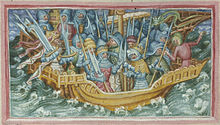
A depiction of Ívarr and Ubba setting forth to avenge their father, Loðbrók, as it appears on folio 47v of British Library Harley 2278.
- 865 the Slap-up Pagan Ground forces, led past Ivar, invaded the Anglo-Saxon Heptarchy.[9] The Heptarchy was the collective proper noun for the seven kingdoms East Anglia, Essex, Kent, Mercia, Northumbria, Sussex and Wessex. The invasion was organised past the sons of Ragnar Lodbrok, to wreak revenge confronting Ælla of Northumbria who had supposedly executed Ragnar in 865 by throwing him in a serpent pit, merely the historicity of this explanation is unknown.[ten] [eleven] According to the saga, Ivar did not overcome Ælla and sought reconciliation. He asked for but equally much land as he could cover with an ox's hide and swore never to wage war confronting Ælla. Then Ivar cutting the ox'southward hide into such fine strands that he could envelop a large fortress (in an older saga information technology was York and according to a younger saga it was London), which he could take every bit his own (compare the like legendary ploy of Dido).
- Belatedly the side by side year, the army turned due north and invaded Northumbria, eventually capturing Ælla at York in 867.[12] Co-ordinate to legend, Ælla was executed by Ivar and his brothers using the blood eagle, a ritual method of execution of debated historicity whereby the ribcage is opened from behind and the lungs are pulled out, forming a fly-like shape.[8] Later in the year, the Army moved due south and invaded the kingdom of Mercia, capturing the town of Nottingham, where they spent the winter. Rex Burgred of Mercia responded past allying with the West Saxon rex Æthelred of Wessex, and with a combined force they laid siege to the town. The Anglo-Saxons were unable to recapture the city, but a truce was agreed whereby the Danes would withdraw to York.[12] The Great Heathen Regular army remained in York for over a year, gathering its strength for further assaults.[12]
- Ivar and Ubba are identified as the commanders of the Danes when they returned to East Anglia in 869, and as the executioners of the East Anglian king, Edmund the Martyr, for refusing their demand that he renounce Christ.[13] The precise business relationship of Edmund's decease is unknown, however it has been suggested that his capture and execution at the hands of the sons of Ragnar is likely to take occurred.[14]
Death [edit]
The Anglo-Saxon chronicler Æthelweard records his expiry as 870.[fifteen] The Annals of Ulster describe the death of Ívar in 873. The expiry of Ívar is also recorded in the Fragmentary Annals of Ireland under the yr 873.[16]
The identification of the king of Laithlind as Gothfraid (i.due east., Ímar's father) was added by a copyist in the 17th century. In the original 11th-century manuscript, the field of study of the entry was simply called righ Lochlann ("the rex of Lochlainn"), which more than than probable referred to Ímar, whose death is not otherwise noted in the Fragmentary Register. The cause of death—a sudden and horrible disease—is not mentioned in whatsoever other source, simply it raises the possibility that the true origin of Ivar's Old Norse nickname lay in the crippling effects of an unidentified disease that struck him down at the end of his life.
In 1686, a farm labourer named Thomas Walker discovered a Scandinavian burying mound at Repton in Derbyshire close to a battle site where the Not bad Heathen Army overthrew the Mercian Rex Burgred of his kingdom. The number of partial skeletons surrounding the body—over 250—signified that the homo buried in that location was of very high status. It has been suggested that such a burial mound is possibly the last resting place of Ivar.[17]
Co-ordinate to the saga, Ivar ordered that he be buried in a identify that was exposed to attack, and prophesied that, if that was done, foes coming to the land would be met with ill-success. This prophecy held true, says the saga, until "when Vilhjalm bastard (William I of England) came ashore[,] he went [to the burying site] and broke Ivar'due south mound and saw that [Ivar'south] body had non decayed. And then Vilhjalm had a big pyre made upon which Ivar's body was] burned... Thereupon, [Vilhjalm proceeded with the landing invasion and achieved] the victory."[18] [19]
Fictional portrayals [edit]
- Ivar the Boneless is a small-scale grapheme in the 1969 moving picture Alfred the Great,[20] portrayed as an acrobatic and active warrior.
- In the 2013 film Hammer of the Gods, Ivar the Boneless is portrayed as a reclusive, homosexual viking. (The character was played past Ivan Kaye, who later portrayed Male monarch Aelle in the History Channel's TV series Vikings.[21])
- In the History Channel'southward 2013 Tv set serial Vikings, Ivar is portrayed as the son of Ragnar and Aslaug and a younger half-brother to Björn Ironside. He showtime appeared in Flavour Two every bit a baby, and later was played by James Quinn Markey and Alex Høgh Andersen.[22]
- Ivar's invasion of E Anglia and killing of Edmund the Martyr are depicted in the video for The Darkness's vocal Barbarian.[23]
- Ivar is a significant character, alongside his brother Ubba in Bernard Cornwell'south Saxon Stories novel series, including the commencement The Concluding Kingdom (2004). Throughout the subsequent boob tube adaptation past the same name, notwithstanding, Ivar remains an unseen grapheme.
- Ivar the Boneless and his brothers Ubba and Halfdan, all announced in the video game, Assassin's Creed: Valhalla equally allies of the chief protagonist, Eivor. Here he is portrayed as extremely aggressive and callous, causing friction with the other characters. Ivar is voiced by Canadian histrion, Eric Johnson.
References [edit]
- ^ Hervey, Francis (1907). Corolla Sancti Eadmundi = The garland of Saint Edmund, male monarch and martyr. London: John Murray. OL 11080612W.
- ^ Costambeys, Marios (2004). "Ívarr [Ívarr inn Beinlausi, Ingwaer, Imhar] (d. 873)". Oxford Dictionary of National Biography. Oxford University Printing. doi:10.1093/ref:odnb/49261. (subscription or UK public library membership required)
- ^ "Leg in Danish". dictionary.cambridge.org . Retrieved 5 February 2021.
- ^ Groeneveld, Emma (12 November 2018). "Ivar the Boneless". World History Encyclopedia.
- ^ a b Bakery, Mick. "Anglo-Saxon Britain: In the Footsteps of Ivarr the Boneless". The History Files . Retrieved 1 September 2016.
- ^ Ferguson, Robert (2009). The hammer and the cross: a new history of the Vikings. London: Allan Lane. ISBN978-0713997880. OCLC 609990781.
- ^ Mahoney, Mike. "Ivar the Boneless". world wide web.englishmonarchs.co.uk . Retrieved 14 Apr 2017.
- ^ a b Holman, Katherine (2007). The northern conquest: Vikings in Britain and Ireland. Oxford: Indicate Books. ISBN9781904955344. OCLC 166381361.
- ^ Venning, Timothy (nineteen June 2013). The Kings & Queens of Anglo-Saxon England. Amberley. ISBN9781445608976.
- ^ Munch, Peter Andreas (10 September 2010). Olsen, Magnus (ed.). Norse Mythology: Legends Of Gods And Heroes. Kessinger Publishing, LLC. ISBN9781164510307.
- ^ Jones, Gwyn (1 November 1984). A History of the Vikings (Revised ed.). Oxford University Printing. ISBN9780192158826.
- ^ a b c Forte, Angelo; Oram, Richard; Pedersen, Frederik (xxx May 2005). Viking Empires (First ed.). Cambridge University Press. ISBN9780521829922.
- ^ Swanton, Michael J., ed. (18 August 1998). The Anglo-Saxon Chronicle (First ed.). Routledge. ISBN9780415921299.
- ^ Mostert, Marco (1 January 1987). The political theology of Abbo of Fleury: A report of the ideas about society and law of the tenth-century monastic reform motility. Verloren. ISBN9789065502094.
- ^ Giles, J. A., ed. (10 September 2010). Six Old English language Chronicles: Ethelwerd's Chronicle, Asser's Life Of Alfred, Geoffrey Of Monmouth's British History, Gildas, Nennius And Richard Of Cirencester. Kessinger Publishing, LLC. ISBN9781163125991.
- ^ "Fragmentary Annals of Republic of ireland 409". CELT. Retrieved ii Feb 2009.
- ^ Arnold, Martin. The Vikings: A Short History past Martin Arnold. The History Printing.
- ^ "Ivar the Boneless, Ragnar Lothbrok's Son - Mythologian.Net". mythologian.net . Retrieved 19 April 2017.
- ^ "Saga of Ivar (The Boneless) Ragnarsson | Up Helly Aa". world wide web.uphellyaa.org . Retrieved 19 April 2017.
- ^ "Alfred the Bully (1969) - Overview - TCM.com".
- ^ "Hammer of the Gods". 30 May 2013 – via IMDb.
- ^ Schwartz, Terri (21 Apr 2016). "Vikings: Run into the 4 New Actors Revealed in Flavor 4'south Midseason Finale". IGN . Retrieved 22 December 2016.
- ^ "The Darkness Return With 'Barbarian' Video: Exclusive Premiere". Billboard.com. Retrieved 2 June 2015.
Source: https://en.wikipedia.org/wiki/Ivar_the_Boneless
0 Response to "What Happened to Ivar's Baby in History Vikings?"
Post a Comment